
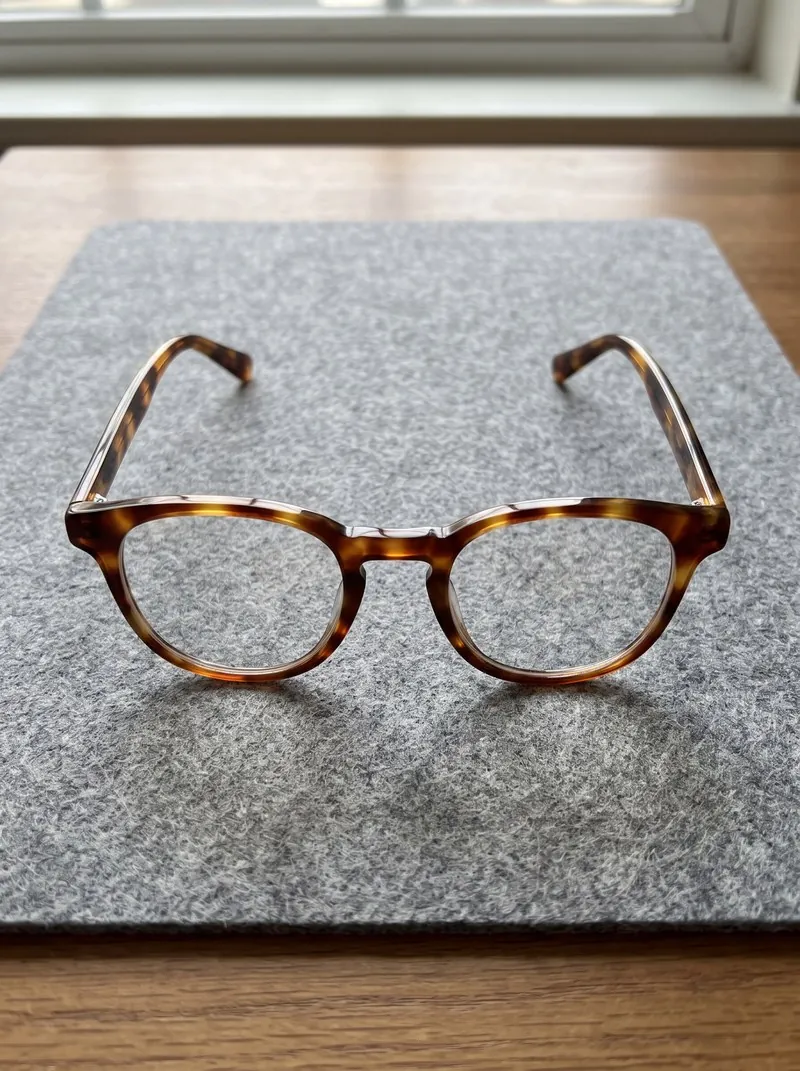
Acetate and metal frames carry different details
An acetate frame is one moulded front with a fixed bridge, and its character lies in the depth of the rim and in the material itself, often a tortoiseshell mottle or a two-tone layer. A metal frame is assembled from thin parts: wire rims, a separate bridge, adjustable nose pads on pad arms and slim temples ending in plastic tips. The brief names the rim thickness, the colour and finish, the bridge, the hinges and the temples for both kinds.
That difference decides where to look. On acetate, compare the mottle and the depth of colour at the corners, where the material is thickest; a pattern in the material is drawn from the photo and repays a close look. On metal, compare the pad arms and the hinge barrels: they are the smallest parts of the frame, and a close look should reach them before anything else.
Clear lenses, coatings and the tint that is not there
Optical frames are photographed with their demo lenses or with lenses already fitted, and an anti-reflective coating on those lenses often shows a faint green or violet sheen in a product photo. The brief treats colour casts and reflections in the source as coming from the light, not from the product, and the eyeglasses category asks for clear lenses with the eyes visible behind them and only soft natural reflections.
A lens with a light functional coating, such as a blue-light filter, is still sold as a clear optical lens, and under eyeglasses it is briefed to appear clear. The function of a coating cannot be seen in any photograph: filtering, prescription and lens material are facts for the listing text, next to the lens width, bridge width and temple length.
Rimless, half-rim and browline frames on a face
Frames with an open edge are the hardest to read on a face. A half-rim or browline frame has a solid upper rim and a lower edge held by a thin nylon cord or by nothing visible; a rimless frame has no rim at all, only lenses drilled and fixed to the bridge and the temples. The brief keeps the frame shape and the rim thickness and is not to redesign the frame, so an open edge is meant to stay open.
Before publishing, follow the lower edge of each lens. A rim drawn where the real frame has none, a lens outline that merges with the cheek, or a drilled mount that has turned into a full rim are all changes to the product. Hold the real pair at the same slight angle as the portrait while comparing, because the open edge changes shape as the frame turns.