Sunglasses held in a hand: the in-hand product photo
Next to the frame on its own, Product studio can show a pair held in a woman's or a man's hand. The brief describes how glasses are really held: by one temple near the hinge, between thumb and index finger, with the temples open and the frame facing the camera. The fingers are not to touch or cover the lenses or the front of the frame, and only the hand and the wrist are in the picture, with no face or body.
An in-hand image gives a sense of scale that a frame on a white ground does not: the width of the frame against a hand reads at once. It suits a gallery position after the main image. Check the hand as closely as the frame: a natural grip, a thumb that does not pass through the temple, a pair that appears once. Fingers that cover a logo on the temple are a reason to generate again.
Podium, stone plinth and linen: scenes for sunglasses
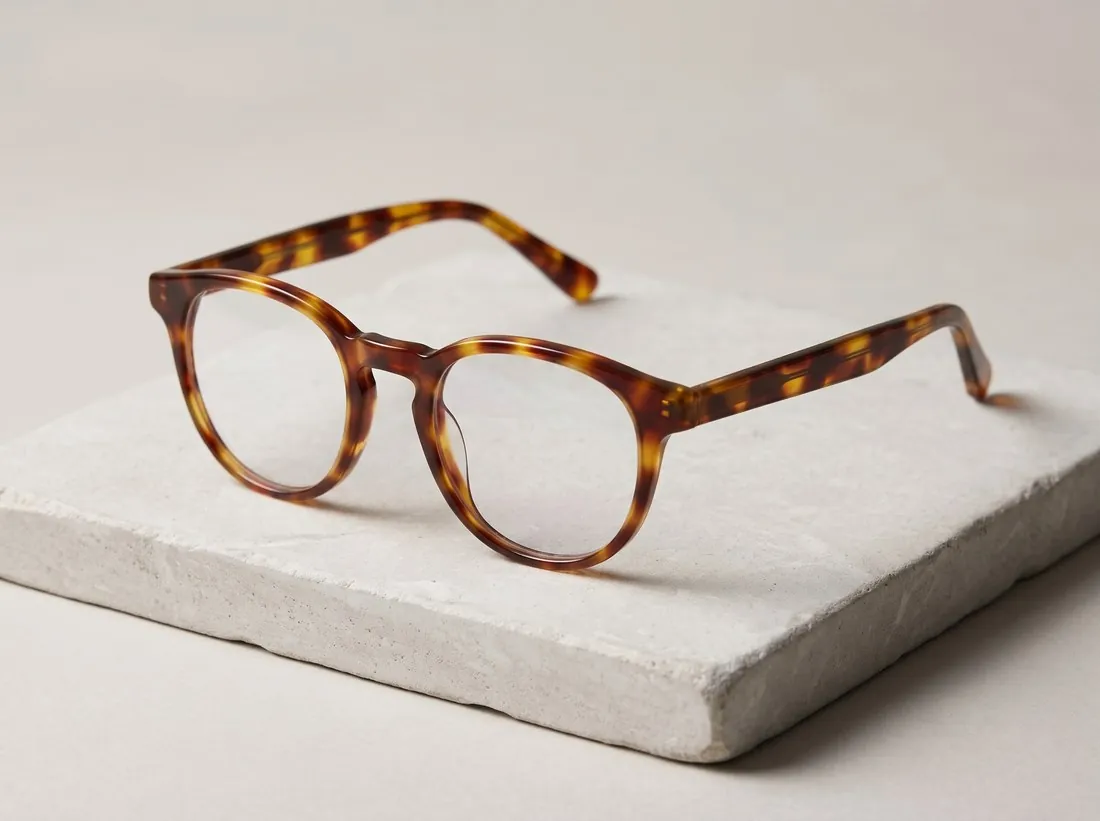
For eyewear, the suggested scenes include a white studio ground with or without a reflection, a podium, a honed stone plinth, linen seen from above and an outdoor setting in natural daylight. A raised surface such as the podium or the plinth lifts the pair towards the height of the camera, so that the front view shows the frame as a face would wear it, with the temple tips resting behind it.
Outdoor light suits sunglasses sold for sport, travel or the beach, and it colours the lenses with the sky and the ground around them. Where the tint is the reason to buy, keep a studio image as the main view and let the outdoor scene follow. Linen seen from above shows the open pair from the top, with the temples spread, which suits a styled image lower in the gallery.
Optical frames and sunglasses in one product range
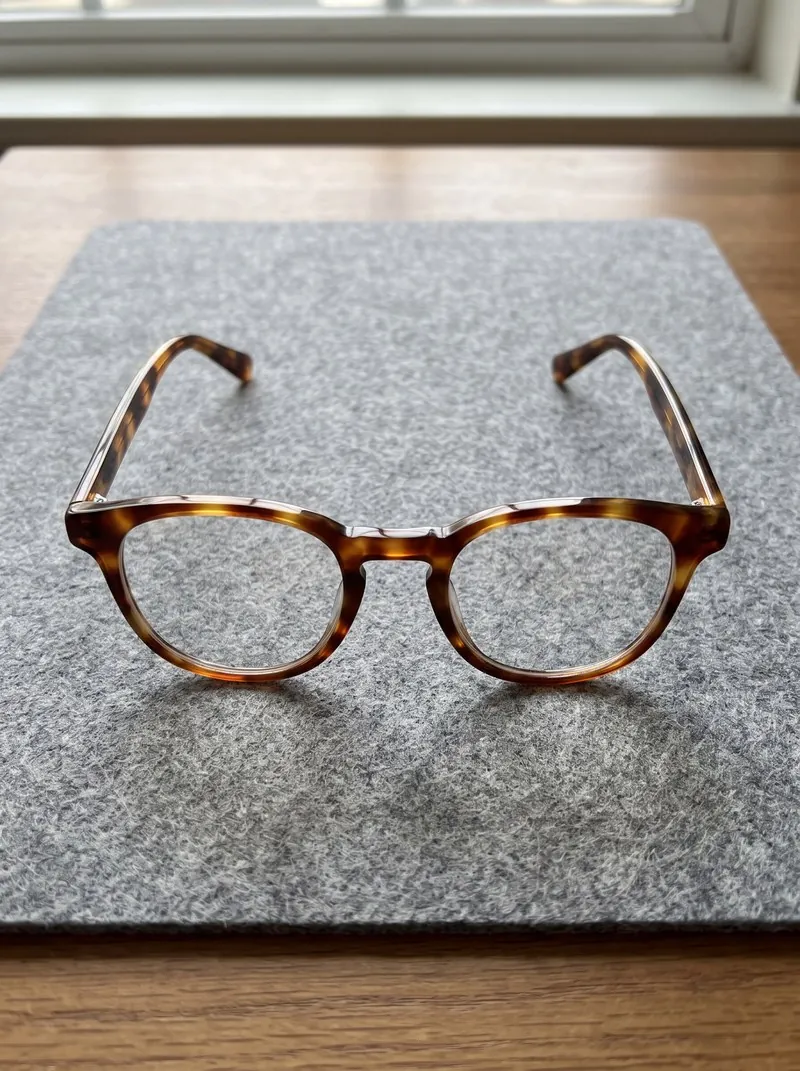
A range that mixes sunglasses and optical frames reads as one collection when every pair is shown alike, on one ground, from one angle and with one kind of shadow. The front view compares lens shapes and bridges across the range, and the three-quarter view is the one to repeat for temple thickness and hinge style. Photograph every pair from the same height and distance, so that frame sizes compare honestly in a grid.
Clear lenses show whatever lies behind them, so through an optical frame the new ground should appear, and the edge of each lens should still show as a thin line. Every pair is briefed to appear open with exactly two temples unfolded, and to keep the frame shape, hinges and lens tint. Thin metal frames deserve the closest look: a nose pad arm, a fine bridge or a screw at the hinge is small at catalogue size.